

- Save
- Share
- Phone
- All Pre-Schools
- prev
- next
Available Grades: Pre-School
-
Ages 18 to 24 months
-
Ages 24 to 36 months
-
Ages 3 to 6 years
-
Grade 0 / R
-
Grade 00 / RR
-
Grade 000 / RRR
-
Grade 0000 / RRRR
Sponsored
About School
Village Montessori School Pre-School is located in Centurion. Village Montessori School was established in 1992 and is registered with the Gauteng Education Department as an Independent School. The medium of instruction is English.
The school is based on the Montessori principles as compiled by Maria Montessori, a well known Italian educator. The basis of the method is the viewpoint that each child has an innate desire to learn. The prerequisite to learning taking place is the existence of a prepared environment where the child can be directed and not taught.
The Village Montessori School is committed to provide a holistic education, which encourages understanding through a questioning mind. We aim to achieve this by:
- Allowing each child to develop intellectually at their own pace with the specially designed programme
- Developing an awareness of the environment and the importance of their role in its stewardship
- Fostering an awareness of their role and responsibilities in society
Quick Facts About Pre-School
Village Montessori Toddler Phase
- 8 to 18 months: Sitters, Standers and Explorers
- 18 months to 24 months: Movers, Shakers and Players
- 24 months to 36 months: Walkers, Talkers and Pretenders
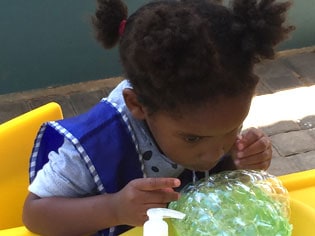
Children learn through doing, imaging and discovering for themselves. It is the discovery and exploration of the senses.
Cognitive Development is about the equilibrium of holistic development and the way the child explores, makes connections and communicates their new discovery.
The toddler child needs to be seen as an active learner. The toddler child will be encouraged to develop ideas, thinking, intelligence, imagination, creativity, concentration, attention, memory, schemas and language development. The toddler child will be developing and strengthening their Gross Motor Skills, Fine Motor Skills, Spatial Orientation, Music, Movement, Art, Emotional, Social and Cognitive Skills through various activities, songs, games, rhythms and play. The Learning Areas also include Practical Life, Knowledge and Understanding of the World, Language and Math Development.
Ages 3 6
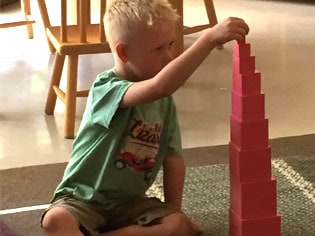
We offer a wide range of educational opportunities for children during the important early formative years. Beginning with practical and social skills, children learn to keep track of their belongings, to put things away, and to share materials. Academics are introduced through concrete, manipulative materials which utilise all five senses and lay the groundwork for abstract thinking.
Exercises of Daily Living
These activities, which Dr Montessori called "Practical Life", prepare children to care for themselves and the environment and give each child a sense of mastery and self-confidence. Performing such tasks as sweeping, polishing, washing, and preparing food, children develop coordination, concentration, and good work habits such as completing a task.
Sensorial Exercises
Montessori materials are designed to heighten the child's senses of sight, touch, sound, taste and smell. By focusing on the senses, children are given a key to understanding and classifying the environment. Distinguishing, categorising, and comparing the concrete lays the foundation for understanding the abstract.
Mathematics
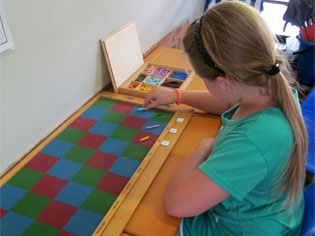
Children's understanding of the basic mathematic operations of addition, subtraction, multiplication, and division emerges from using manipulative materials such as rods, beads, sandpaper numerals, cards and counters which allow the child to visualise the abstraction of numbers. Using self-correcting materials, children learn not only number recognition and place value, but also to solve problems and to develop a visual image of mathematical concepts.
Reading and Writing
The pre-school child is immersed in developing language, and effortlessly links sound, symbols and shapes. Using simple alphabet cut outs and sandpaper letters, children learn the sounds of letters and soon are linking letters to make words, then words to make sentences.
Children first develop small muscle coordination necessary to master writing in their activities of daily living and in using the sensorial materials. After tracing geometric figures with a pencil, cutting shapes with scissors, and tracing letters with their fingers, they soon progress to writing letters.
Cultural Subjects
History, geography, science, art, and music are referred to as cultural subjects. Children learn about people, their countries, and the world through food, music, pictures, flags, maps, artefacts, the celebration of holidays, and scientific experiments and observations.
To aid the child's understanding of biology and to enhance the student's love of nature and experience with living things, the school often invites groups to bring animals to the school, for example fish, reptiles, amphibians, birds, and mammals. Small gardens and plants are cared for by the children.
Pre-School Features
Extra Murals - Pre-School
Sport
Facilities
Budget
- $$ - ( R 30 000 - R 50 000 pa )
School Phase
Sponsored
City
-
Centurion
Gender: Pre-School
-
Gender: Mixed (Co-Ed)
School Sector
-
Independent
Government Registration
-
GDE
Accreditation
-
SAMA (Montessori)
Curriculum: Pre-School
-
Montessori
Open
-
Monday
07:30 - 16:00
-
Tuesday
07:30 - 16:00
-
Wednesday
07:30 - 16:00
-
Thursday
07:30 - 16:00
-
Friday
07:30 - 16:00
-
Saturday
Closed
-
Sunday
Closed
04/06/2026 08:24 local time
Location
245 Glover Ave, Lyttelton Manor, Centurion, South Africa
Contact Details
-
Website
-
Phone
Reviews
Add a review
 Loading ...